MHealSec, PGCertHelSc
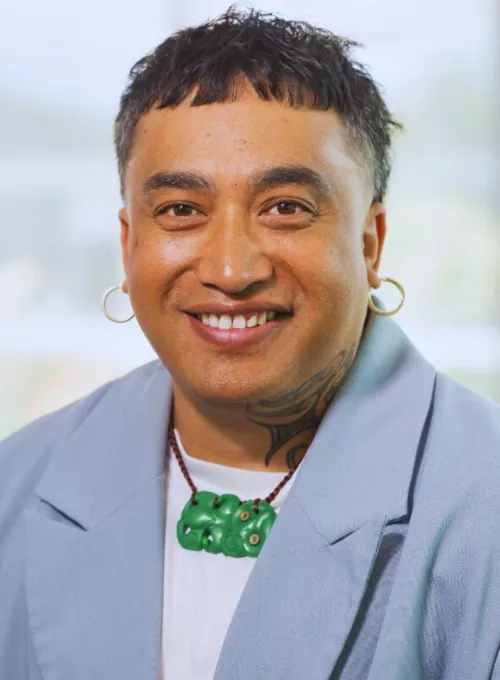
Mau Te Rangimarie Clark is an emerging Māori health researcher dedicated to challenging systemic inequities in mental health and improving healthcare for Māori. His work focuses on Kaupapa Māori methodologies, ensuring that Māori voices and lived experiences are central to health research and policy reform.
Mau's research spans eating disorders, bipolar disorder, and psychosis in Māori communities, providing a crucial lens on the intersection of mental health and colonisation.
As an Assistant Research Fellow at the University of Otago, he is pioneering efforts to develop culturally appropriate responses to Māori mental health needs, advocating for whānau-centred and kaupapa Māori approaches to care.
Mau Te Rangimarie’s academic pathway reflects his deep commitment to Māori health and indigenous research. His qualifications include:
- Master of Health Sciences (Mental Health) – University of Otago (2025), advancing Māori-centred mental health research.
- Postgraduate Degree in Health Sciences (Mental Health) – University of Otago (2022), focusing on kaupapa Māori approaches to mental well-being.
- Bachelor of Arts in Anthropology & Māori Indigenous Studies – University of Canterbury (2017), grounding his work in indigenous knowledge systems.
Mau’s research has been instrumental in reshaping the discourse on Māori mental health, addressing the impact of racism, colonisation, and systemic bias in mental health care. His groundbreaking work includes:
- Ngā Māuiui Kai: Creating Māori Terms for Eating Disorders: Bridging Cultural Gaps in Diagnosis and Treatment. Journal of Eating Disorders article 2024.
- Institutional Pathways to Psychosis for Māori – Unpacking how Māori experience the mental health system. SSM - Qualitative Research in Health June 2024
- The Right to Equal Health: Best Practice Priorities for Māori with Bipolar Disorder – Addressing gaps in care. Healthcare 2024, 12(7), 793.
As a co-Director of Te Haa O Io, Mau leads kaupapa Māori research that challenges Eurocentric health models and promotes Māori-led solutions. His research is widely published in national and international journals, shaping how mental health services evolve for Māori.
Mau’s work highlights how colonial narratives continue to shape mental health services, often disadvantaging Māori seeking diagnosis and treatment. His studies call for urgent reforms in clinician training, service access, and policy development to ensure mana-enhancing, culturally safe healthcare environments for Māori.
Mau Te Rangimarie Clark’s research and advocacy are paving the way for a more inclusive, culturally responsive health system. His commitment to validating Māori realities in mental health research ensures future generations will receive care that honours their identity, whakapapa, and mana.
"Mental health systems must be redesigned with Māori voices leading the way—anything less is a continuation of colonial harm."
Links:
Research Gate Profile - Mauterangimarie Clark
Cancer diagnosis after emergency presentations in people with mental health and substance use conditions: a national cohort study. Article in BMC Cancer 24, 546 (2024). 30 April 2024.
Experiences of physical healthcare services in Māori and non-Māori with mental health and substance use conditions. Article in Australian & New Zealand Journal of Psychiatry. 2024;58(7):591-602. 20 March 2024.
‘E koekoe te Tūī, e ketekete te Kākā, e kuku te Kererū, The Tūī chatters, the Kākā cackles, and the Kererū coos’: Insights into explanatory factors, treatment experiences and recovery for Māori with eating disorders – A qualitative study. Article in Australian & New Zealand Journal of Psychiatry. 2023;58(4):365-372. 27 October 2023.
Racism, early psychosis, and institutional contact: A qualitative study of Indigenous experiences. Article in International Journal of Social Psychiatry. 2023;69(8):2121-2127.
Do patients with mental health and substance use conditions experience discrimination and diagnostic overshadowing in primary care in Aotearoa New Zealand? Results from a national online survey. Article in Journal of Primary Health Care 15(2) 112-121. 19 May 2023
Reimagining eating disorder spaces: a qualitative study exploring Māori experiences of accessing treatment for eating disorders in Aotearoa New Zealand. Article in Journal of Eating Disorders 11. 15 February 2023.
It absolutely needs to move out of that structure’: Māori with bipolar disorder identify structural barriers and propose solutions to reform the New Zealand mental health system. Article in Ethnicity & Health Volume 28, 2023 - Issue 2
Is there systemic bias for Māori with eating disorders? A need for greater awareness in the healthcare system. Article in NZMJ 8 May 2020, Vol 133 No 1514
Binge Eating: Food + Family with Bubba Aiono + Mauterangimarie Clark (Audio) Podcast 17 November 2020
Te Whāriki o te Ara Oranga (Whāriki) Manukura | Mau Te Rangimarie Clark Profile
28 April 2025