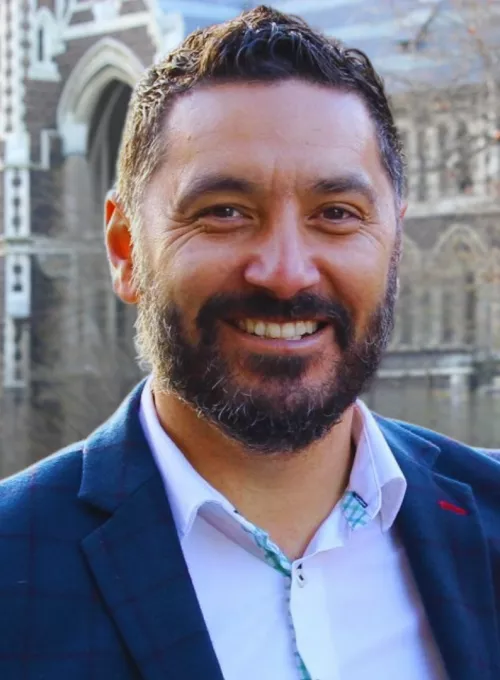
BSc, MSc, PGDipClinPsych, PhD
Dr. Simon Te Manihi Bennett is a distinguished clinical psychologist and academic dedicated to enhancing Māori mental health through culturally responsive therapeutic practices and education.
Born in Christchurch and raised in Northland, he is the son of Bruce Rongomai and Rana Tui Bennett, a devoted husband, brother, and father to four children. His personal and professional journey is deeply rooted in his whānau and cultural heritage, shaping his commitment to improving mental health outcomes for Māori communities.
Dr. Bennett embarked on his academic path at Massey University, where he completed:
- Bachelor of Arts in Psychology BA (Psychology)
- Postgraduate Diploma in Clinical Psychology (PGDipPsychPrac)
Following his clinical training, he worked as a clinical psychologist at Te Whare Marie, a specialist kaupapa Māori mental health service in Wellington. His work with Māori clients highlighted the need for culturally tailored therapeutic interventions, inspiring him to pursue further research in this area.
Dr. Bennett earned his PhD in Clinical Psychology from Massey University in 2009, funded by a Health Research Council Clinical Research Fellowship. His doctoral thesis, Te Huanga o te Ao Māori: Cognitive Behavioural Therapy for Māori Clients with Depression – Development and Evaluation of a Culturally Adapted Treatment Programme, explored ways to integrate Māori concepts into traditional Cognitive Behavioural Therapy (CBT).
His research resulted in a manualised CBT programme designed specifically for Māori clients, incorporating Māori processes such as whānau engagement, spirituality, and metaphor-based learning. The adapted intervention significantly reduced depressive symptoms, demonstrating the power of culturally tailored mental health approaches.
Dr. Bennett is a Senior Lecturer at Massey University’s School of Psychology, where he has been a key figure in developing culturally competent psychological training. In 2018, he became Massey’s first Māori Director of Clinical Psychology Training, leading efforts to embed Te Tiriti o Waitangi principles into the curriculum and improve responsiveness to Māori mental health needs
Dr. Bennett has authored and co-authored numerous research papers on Māori mental health, culturally adapted therapies, and bicultural issues in clinical psychology. His work includes:
- Culturally Adapted Cognitive Behavioural Therapy for Māori with Major Depression – Evaluating the effectiveness of a CBT treatment protocol tailored for Māori
- Contributions to Māori mental health strategy reports and academic journals, influencing policy and practice in Aotearoa’s mental health sector.
In 2014, Dr. Bennett was awarded a Fulbright Scholarship, which took him to the Centers for American Indian and Alaska Native Health in Denver, Colorado. This experience expanded his expertise in Indigenous mental health, reinforcing his commitment to developing Māori-led mental health frameworks that align with global Indigenous best practices.
Dr. Bennett has been actively involved in Māori academic support programmes such as Massey University’s Te Rau Puawai, both as a board member and former bursar, providing guidance and mentorship to Māori students pursuing careers in psychology. His work extends beyond academia into advocacy for Māori-led mental health initiatives, ensuring that culturally grounded, evidence-based interventions are implemented across health services.
Dr. Simon Bennett’s contributions to Māori mental health have been profound. His research and leadership have directly influenced policy, clinical practice, and education, ensuring that psychological services in Aotearoa are more accessible, effective, and culturally responsive for Māori.
His unwavering commitment to whānau, hapū, and iwi continues to shape the future of mental health care in Aotearoa, providing a legacy of kaupapa Māori-driven research and practice.
Through his pioneering work, Dr. Bennett exemplifies the integration of Mātauranga Māori and Western psychology, ensuring that mental health services truly reflect the needs and aspirations of Māori communities.
Links:
Bennett, STM. (2018). Transforming psychological services for Māori. In TK. Kingi (Ed.) Maea te Toi Ora: Māori Health Transformations. (pp. 193 - 223): Huia Publishers
Te huanga o te ao Maori : Cognitive Behavioural Therapy for Maori clients with depression
Research Gate Profile: Simon Te Manihi Bennett
Considerations for Culturally Responsive Cognitive-Behavioural Therapy for Māori With Depression Open access article Journal of Pacific Rim Psychology Bennett, S. T., Flett, R. A., & Babbage, D. R. (2016). Considerations for Culturally Responsive Cognitive-Behavioural Therapy for Māori With Depression. Journal of Pacific Rim Psychology, 10. https://doi.org/10.1017/prp.2016.5
Culturally adapted cognitive behaviour therapy for Māori with major depression, December 2014 Article abstarct
Cultural Adaptation of CBT for Aboriginal Australians Bennett, Simon & Babbage, Duncan. (2014). Cultural Adaptation of CBT for Aboriginal Australians. Australian Psychologist. 49. 10.1111/ap.12029.
Cognitive Behavioral Therapy in Aotearoa/New Zealand Mathieson, Fiona & Bennett, Simon & Cargo, Tania & Froggatt, Wayne. (2022). Cognitive Behavioral Therapy in Aotearoa/New Zealand. 10.1007/978-3-030-82555-3_2.
A proposed Hauora Māori clinical guide for psychologists: Using the Hui Process and Meihana Model in clinical assessment and formulation Pitama, Suzanne & Bennett, Simon & Waitoki, Waikaremoana & Haitana, Tracy & Valentine, Hukarere & Pahina, John & Taylor, Joanne & Tassell-Matamua, Natasha & Rowe, Luke & Beckert, Lutz & Palmer, Suetonia & Huria, Tania & Lacey, Cameron & Mclachlan, Andre. (2017). A proposed Hauora Māori clinical guide for psychologists: Using the Hui Process and Meihana Model in clinical assessment and formulation. New Zealand Journal of Psychology. 46.
Historical trajectories for reclaiming an indigenous identity in mental health interventions for Aotearoa/New Zealand—Māori values, biculturalism, and multiculturalism Ngā Rākau a te Pākehā: Matiu’s Story Bennett, Simon & Liu, James. (2017). Historical trajectories for reclaiming an indigenous identity in mental health interventions for Aotearoa/New Zealand—Māori values, biculturalism, and multiculturalism. International Journal of Intercultural Relations. 10.1016/j.ijintrel.2017.05.005.
Does Learning About Near-Death Experiences Promote Psycho-Spiritual Benefits in Those Who Have Not Had a Near-Death Experience? Tassell-Matamua, Natasha & Lindsay, Nicole & Bennett, Simon & Valentine, Hukarere & Pahina, John. (2016). Does Learning About Near-Death Experiences Promote Psycho-Spiritual Benefits in Those Who Have Not Had a Near-Death Experience?. Journal of Spirituality in Mental Health. 19. 1-21. 10.1080/19349637.2016.1206844.
Te Hua o Te Ao Māori Bennett, Simon. (2001). Te Hua o Te Ao Māori. He Pukenga Korero. 6. 29-34.
Cultural identity and academic achievement among Māori undergraduate university students
Uploaded 24 February 2025